Insights4 min read
NVIDIA Nemotron: The Open AI Model Everyone in Tech Is Suddenly Talking About
Utkarsh Raj
It’s not from OpenAI. It’s not from Google. And it’s not even primarily a chatbot company. So why is NVIDIA’s Nemotron dominating AI conversations right now?
For years, NVIDIA was the company behind the scenes — making the chips that powered everyone else’s breakthroughs. OpenAI, Anthropic, Google: they all ran on NVIDIA hardware, but NVIDIA didn’t build the models people actually talked to. With the Nemotron family, that changed, and the developer community has noticed in a big way.
- What Nemotron Actually Is
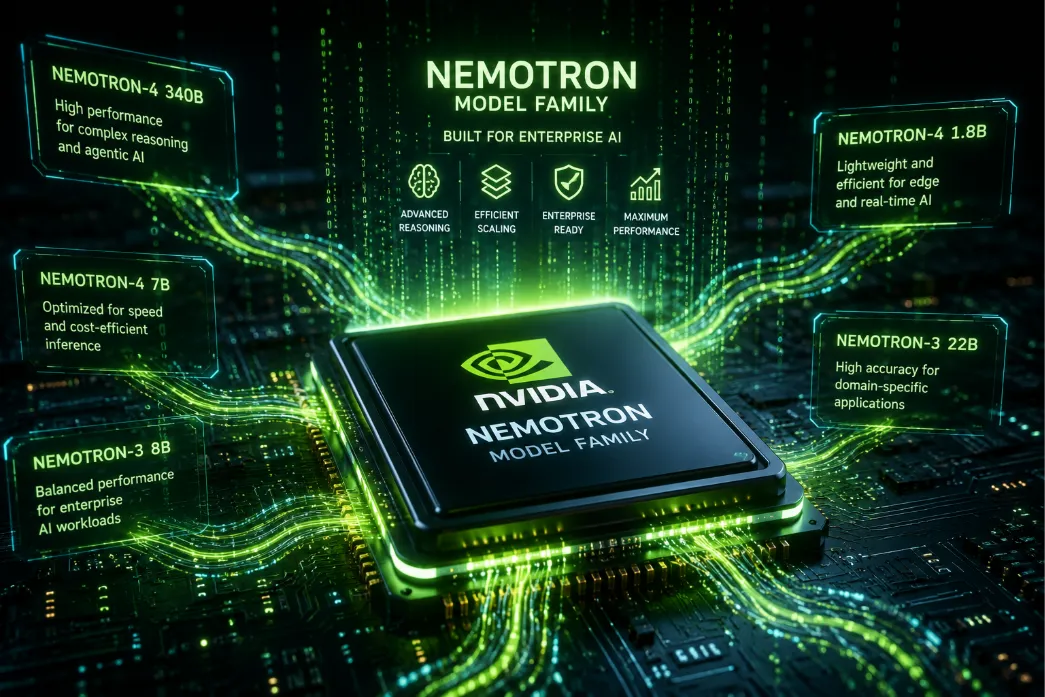
- Nemotron is NVIDIA’s family of open-weight AI models — meaning the actual model files are publicly downloadable, not locked behind an API the way ChatGPT or Claude are. Anyone can download it, run it on their own servers, tweak it, and build products on top of it without needing NVIDIA’s permission for every use case.
The current generation, Nemotron 3, ships in three sizes:
- Nano — small, fast and efficient, including a multimodal “Omni” version that handles text, images, video and audio together.
- Super — mid-size, aimed at collaborative multi-agent systems.
- Ultra — the flagship — a 550-billion-parameter model built for long, complex, autonomous tasks.
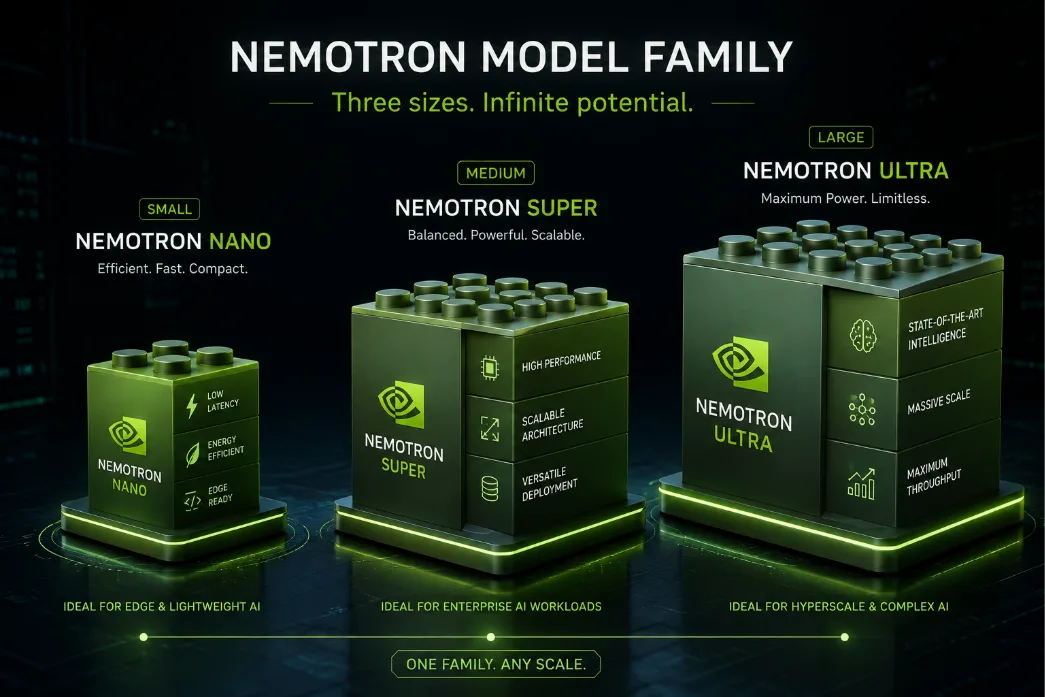
The three sizes, drawn to scale. A list of names cannot show the thing that actually decides which one you run. NVIDIA has also formed the Nemotron Coalition — a group of AI labs pushing open, transparent model development forward, rather than leaving it inside a handful of closed companies.
- What Turns Heads
Massive context. Ultra handles roughly a million tokens in a single pass — around 750,000 words. It can read an entire codebase, a stack of long documents or hours of conversation history and reason across all of it at once, without chopping it into pieces first.
Built for agents, not chat. The interesting AI work now is agents: systems that complete multi-step tasks, use tools and make decisions along the way. Nemotron was trained for exactly that — planning, calling external tools, and carrying out long chains of actions reliably.
Genuinely fast. A hybrid Mamba-and-Transformer mixture-of-experts design activates only a small fraction of its parameters for any task, so it runs faster and cheaper than a model its size should, with some benchmarks showing notably higher throughput than competing open models.
Multimodal from the ground up. Nano Omni handles text, images, video and audio in one unified system rather than stitching separate tools together — useful for an agent processing a screen recording, a PDF and a voice note at once.
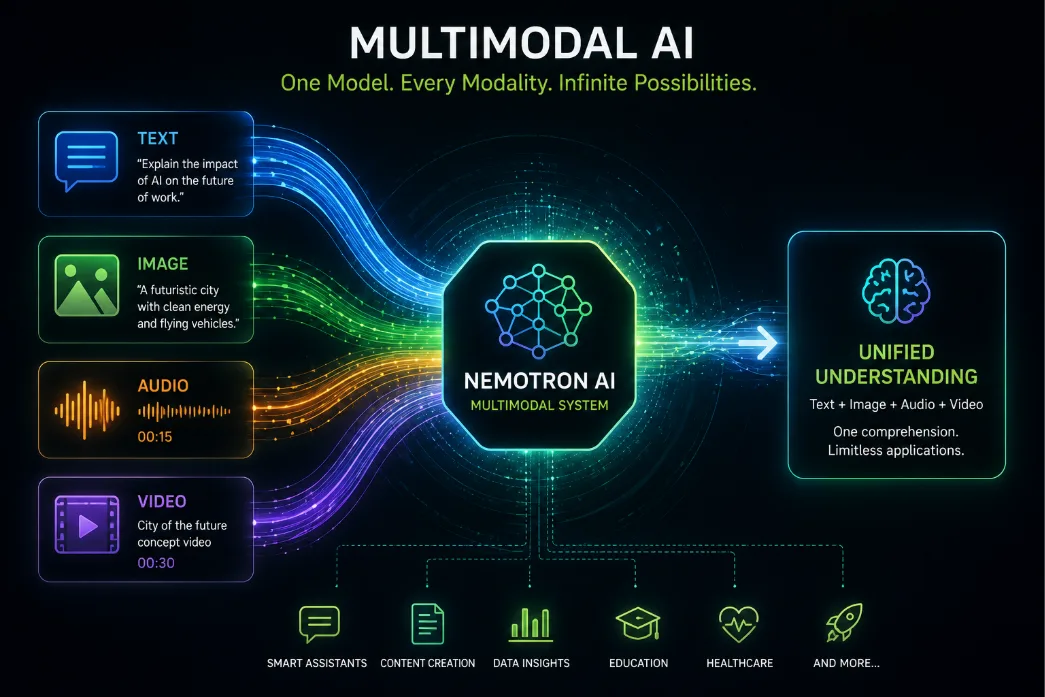
One model, four modalities. The claim is that this is a single system rather than four tools stitched together — which is what makes it usable by an agent. - Why Developers Care
- This is where the hype starts to make sense.
Open weights mean freedom. You can run it entirely on your own infrastructure — which matters enormously in healthcare, finance and government, where sending sensitive data to a third-party API isn’t an option.
No per-token lock-in. Closed models like GPT‑5 or Claude bill per token, every single time. After the infrastructure cost, self-hosted Nemotron doesn’t — a serious advantage at scale.
A permissive license. Commercial use, modification and redistribution are allowed, without forcing you to open-source whatever you build on top of it.

All three reasons come down to the same one: the model runs on infrastructure you control, and nothing leaves it. - How It Stacks Up
- Here’s the honest picture, without the marketing spin.
Vs. closed frontier models (GPT‑5, Claude, Gemini): they generally still lead on raw intelligence benchmarks. But they’re closed — no downloadable weights, no self-hosting, no full customization. Nemotron trades some of that top-end capability for transparency, control and cost.
Vs. other open-weight models (Llama, Qwen, DeepSeek, Kimi): Nemotron 3 Ultra leads U.S.-built open models on independent benchmarks, though the Chinese labs behind Kimi and DeepSeek arguably still lead globally. Nemotron’s real edge isn’t raw intelligence — it’s speed and efficiency for agentic workloads, backed by NVIDIA’s hardware optimization advantage.
The bottom line: if you want the single smartest model available and don’t mind paying per token through an API, closed models still have an edge. If you want a model you can own, run privately and optimize for fast, cost-efficient agent workflows, Nemotron is one of the strongest options on the table.
- Why This Moment Matters
- The bigger story isn’t “NVIDIA made a good model.” It’s that the company controlling the hardware underneath nearly every major AI lab has decided to compete directly in the model layer too — and is giving the technology away as open weights instead of locking it behind an API. Instead of a handful of companies controlling both the chips and the intelligence running on them, real capability goes to anyone willing to download it.

The part of the story that is not about a model: capability anyone can download is capability anyone can build on.
In closing
Nemotron isn’t hype for hype’s sake. It’s a genuinely capable, genuinely open family of models arriving exactly as the industry shifts from “AI that chats” to “AI that acts.”
The age of AI being locked entirely behind a handful of APIs is quietly starting to crack open. And NVIDIA, of all companies, just handed developers one of the biggest hammers.